Showing posts with label Tafsiran. Show all posts

Thursday, July 22, 2010

On Holidays, Costumes, and Innocent Fun

A Note from Pastor Fred

It is becoming increasingly common to hear Christians place much importance on the fact that holidays such as Halloween and Christmas have some ugly chapters in their history. And it is true. There are associations with everything from paganism to occultism to Roman Catholicism. And it is true that Halloween is increasingly used for the advancement of the so-called black arts. And it is further true that Christmas has pagan and superstitious skeletons in its heritage as well. And it must be admitted that the world has done about all it can to remove anything "Christian" from both Christmas and Thanksgiving. Many Christians are urging their brethren to dissociate themselves from these holidays, because for many people they have become a good excuse for a party and nothing more – and often much less.

I understand that reasoning, and I am sure that much of it stems from an honest desire to remain un-contaminated from worldly ideals. But, I'm not at all sure that the non-observance of any of these "holidays" is at all required of the Christian. Let me explain.


First, let's take Halloween. I am not convinced that it is sinful to allow our children to dress up in silly costumes and go out to collect candy on October 31 each year. I am not comfortable with our society's increasing fascination with the dead and the devil, etc., on this day, but I don't think this makes "innocent" fun on the evening of October 31impossible. Nor do I think it matters what the history is – as interesting as it may be. We must not participate in what is itself sinful, but I cannot see where any Biblical injunction forbids costumes and candy on any day, including October 31. And so it seems to me that this must be within the scope of Christian liberty. I would caution against any fascination with what is in itself wrong or even dangerous. But I just cannot see how this disallows all costumes and candy. And I think we should be extremely careful not to add to the Scripture's catalogue of sins.

Thanksgiving? There is probably no more "Christian" holiday than Thanksgiving! But this holiday is also being increasingly paganized by our society – be sure to notice all the news items about the Indians and their celebration customs which you will see next month! But even so, few Christians yet will argue that it is wrong to have turkey dinner with the family. And that is as it should be. We should not be surprised when the world behaves like the world. And with the full realization that there are no "holy days" in this age, we may be sure that most any excuse to have quality family time is a good one.

So then, what about Christmas? It is true – it's history stems from compromises with pagan holidays. It is true that even the name reflects Roman Catholic theology – "Christ Mass." I don't like that. It is also true that we cannot be sure at all that Jesus was born on December 25 – in fact, I rather doubt it. And again, there are no holy days in this New Covenant age. And of course Santa Clause himself is a myth. But the question is this: is it therefore wrong to decorate, exchange gifts, party, celebrate, and get together for family dinners on December 25? Hardly. Personally, I'll take most any excuse for family fun. And I thoroughly enjoy giving gifts to friends and family. And, yes, I'll confess – I don't mind receiving gifts either! Further, I am glad to see families gather together in love and happiness at least once in the year. In fact, I cringe when I hear Christians denouncing the observance of Christmas; the world looks on with wonder – "Christian Scrooge!" – and common ground is needlessly lost. Moreover, I also cringe when I see parents and husbands withholding this opportunity for fun from their families. "No decorations!" "No tree!" "No Santa in this house!" and so on it goes. And I fear that hard feelings are needlessly created when so much good could be accomplished by taking advantage of the season.

Have I reversed the argument? Am I now arguing that the observance of Christmas is a Christian duty? Hardly. But if you detect here a warning against any legalistic spirit, then you are reading me correctly. Legalism is deadly. And I do wish many Christians would fear it more than they fear Santa. I have yet to see where the little Santa decorations in our house have hurt my children. But I have seen many times where legalism in homes has run children away.

Personally, I'm not into decorations. If it were up to me to get them up, they'd be gone forever. It's just not my thing. But I do enjoy seeing them! But my family enjoys it – and they have free reign. I will not add to God's catalogue of sins, and I will not make restrictions where God does not.

So, my counsel concerning holidays and costumes and customs and traditions – do as you like! Help yourself! Have fun! Avoid that which is sinful at all costs; but in all other things, make up your own mind. And please, allow your brother the same privilege.

by : Pastor Fred G. Zaspel
Selengkapnya...(Read More)

Friday, July 16, 2010

Balaam

Meaning: Lord of the people; foreigner or glutton, as interpreted by others
The son of Beor, was a man of some rank among the Midianites (Num. 31:8; compare 16). He resided at Pethor (Deut. 23:4), in Mesopotamia (Num. 23:7). It is evident that though he lived among idolaters, he had some knowledge of the true God; and was held in such reputation that it was supposed that he whom he blessed was blessed, and he whom he cursed was cursed.
When the Israelites were encamped on the plains of Moab, on the east of Jordan, by Jericho, Balak sent for Balaam “from Aram, out of the mountains of the east,” to curse them; but by the remarkable interposition of God he was utterly unable to fulfil Balak's wish, however desirous he was to do so.


The apostle Peter refers (2 Pet. 2:15,16) to this as an historical event. In Micah 6:5 reference also is made to the relations between Balaam and Balak. Though Balaam could not curse Israel, yet he suggested a mode by which the divine displeasure might be caused to descend upon them (Numbers 25). In a battle between Israel and the Midianites (q.v.) Balaam was slain while fighting on the side of Balak (Num. 31:8).
The “doctrine of Balaam” is spoken of in Rev. 2:14, in allusion to the fact that it was through the teaching of Balaam that Balak learned the way by which the Israelites might be led into sin. (See NICOLAITANES.) Balaam was constrained to utter prophecies regarding the future of Israel of wonderful magnificence and beauty of expression (Num. 24:5-9, 17).

Selengkapnya...(Read More)

Is there any evidence to prove the existence of the prophet, Balaam?

In an unprecedented discovery, an ancient text found at Deir Alla, Jordan, in 1967 tells about the activities of a prophet named Balaam. Could this be the Balaam of the Old Testament?
The text makes it clear that it is. Three times in the first four lines he is referred to as “Balaam son of Beor,” exactly as in the Bible. This represents the first Old Testament prophet to be dug up in Bible lands—not his tomb or his skeleton, but a text about him. The text also represents the first prophecy of any scope from the ancient West Semitic world to be found outside the Old Testament, and the first extra-Biblical example of a prophet proclaiming doom to his own people.


Balaam was not an Israelite. He was hired by Balak, king of Moab, to curse the Israelites. They were camped on the east side of the Jordan river, about to make their historic entry into the promised land. Through God's intervention, Balaam was obliged to bless the Israelites rather than curse them (Num 22-24).
Afterwards, Balaam seems to have been the cause of the Israelites' sin in Numbers 25 when they took Moabite and Midianite women and worshipped the Moabite god Baal-peor (Num 31:16).
Balaam was eventually killed when Moses sent the Israelites against the Midianites (Num 31). He is further condemned in Scripture in 2 Peter 2:15 (he loved the wages of unrighteousness), Jude 11 (ungodly men ran greedily after the error of Balaam for reward) and Revelation 2:14 (he taught Balak to cast a stumbling block before the children of Israel, to eat things sacrificed to idols, and to commit fornication).
The remarkable text found at Deir Alla consists of 119 fragments of plaster inscribed with black and red ink. It was among the rubble of a building destroyed in an earthquake. It seems to have been one long column with at least 50 lines, displayed on a plastered wall. According to the excavators' dating, the disaster was most likely the severe earthquake which occurred in the time of King Uzziah (Azariah) and the prophet Amos in about 760 BC (Amos 1:1; Zec 14:5). The lower part of the text shows signs of wear, indicating that it had been on the wall for some time prior to the earthquake.
Written in Aramaic, the text begins with the title "Warnings from the Book of Balaam the son of Beor. He was a seer of the gods." It is in red ink, as are other portions of the text where emphasis is desired. The reference to the "Book of Balaam" indicates that the text was part of a pre-existing document and therefore the original date of the material is much earlier than the plaster text itself. Balaam goes on to relate a vision concerning impending judgment from the gods, and enters into a dispute with his listeners.
There are a number of similarities between the text and the account of Balaam in the book of Numbers. To begin with, the events described in Numbers 22-24 took place in the same general area where the text was found. At the time of the Numbers 22-24 incident, the Israelites were camped on the Plains of Moab, across the Jordan river from Jericho. Deir Alla is located about 25 miles north of this area, where the Jabbok river flows into the Jordan valley. Balaam was from Pethor, near "the river" (Num 22:5), in "Aram" (Num 23:7; Dt 23:4).
The reference to Aram has led most scholars to conclude that Balaam was from northern Syria, in the vicinity of the Euphrates river. That does not fit well with the Biblical account, however, since Balaam's home seems to have been close to where the Israelites were camped (Num 22:1-22; 31:7-8).
In view of Balaam being revered at Deir Alla, one would expect that Deir Alla was his home. This is exactly what William Shea has proposed, based on his reading of the name Pethor in an inscribed clay tablet found at Deir Alla (1989:108-11). In this case, the river of Numbers 22:5 would be the Jabbok river and the naharaim (two rivers) of Deuteronomy 23:4 would be the Jabbok and Jordan rivers.
With regard to the references to Aram, Shea suggests that the original place name was Adam, with the “d” being miscopied as “r,” since the two letters are nearly identical in ancient Hebrew. Adam was a town about eight miles southwest of Deir Alla, on the east bank of the Jordan river, where the Jabbok meets the Jordan.
Balaam evidently was well known as a "cursing prophet," for Balak specifically summoned Balaam for the purpose of cursing Israel (Num 22:6). Much of the Deir Alla text was given to curses uttered by the prophet. The term “shadday-gods” is used on two occasions in the text. Shadday is one of the names for God in the Old Testament, used mainly in the book of Job. Since the account of Job is set in Transjordan (Job 1:1-3), it seems that Shadday was a name used for deity in this region. Balaam used the name twice in his blessing speeches where it is translated “Almighty” (Num 24:4, 16).
The Deir Alla text presents a problem to those who dismiss the Biblical account of the Exodus, Wilderness Wanderings and Conquest as legendary, as is the trend in scholarship today. It is clear that Balaam was a real person who operated on the east side of the Jordan river. He was known as a cursing prophet and continued to be revered hundreds of years after his death. His persona as revealed in the Deir Alla text precisely matches that of the Balaam of Numbers 22-24. If Balaam was a real person, what about Balak, Moses, Joshua and all of the other persons named in the Biblical narrative? They must have been real as well, and the events described authentic.

Recommended for further reading
1. Dijkstra, M. "Is Balaam Also Among the Prophets?" Journal of Biblical Literature. 1995. 114: 43-64.
2. Shea, W.H. "The Inscribed Tablets From Tell Deir `Alla". Andrews University Seminary Studies. 1989. 27: 21-37; 97-119.
3. Wood, B.G. "Prophecy of Balaam Found in Jordan". Bible and Spade. 1977. 6: 121-24.

Selengkapnya...(Read More)

Prophecy (or prediction)

This was one of the functions of the prophet. It has been defined as a “miracle of knowledge, a declaration or description or representation of something future, beyond the power of human sagacity to foresee, discern, or conjecture.” (See PROPHET.)
The great predictions which run like a golden thread through the whole contents of the Old Testament are those regarding the coming and work of the Messiah. The great body of Old Testament prophecy relates directly to the advent of the Messiah, beginning with Gen. 3:15, the first great promise, and extending in ever-increasing fulness and clearness all through to the very close of the canon. The Messianic prophecies are too numerous to be quoted here. “To him gave all the prophets witness.” (Compare Micah 5:2; Hag. 2:6-9; Isa. 7:14; 9:6, 7; 11:1, 2; 53; 60:10, 13; Ps. 16:11; 68:18.)


Many predictions also were delivered by Jesus and his apostles. Those of Christ were very numerous. (Compare Matt. 10:23-24; 11:23; 19:28; 21:43, 44; 24; 25:31-46; 26:17-35, 46, 64; Mark 9:1; 10:30; 13; 11:1-6, 14; 14:12-31, 42, 62; 16:17, etc.)
The great use of prophecy was to perpetuate faith in his coming, and to prepare the world for that event. But there are many subordinate and intermediate prophecies, also, which hold an important place in the great chain of events which illustrate the sovereignty and all-wise overruling providence of God.
Then there are many prophecies regarding the Jewish nation, its founder Abraham (Gen. 12:1-3; 13:16; 15:5; 17:2, 4-6, etc.), and his posterity, Isaac and Jacob and their descendants (12:7; 13:14, 15, 17; 15:18-21; Ex. 3:8, 17), which have all been fulfilled.
The twenty-eighth chapter of Deuteronomy contains a series of predictions which are even now in the present day being fulfilled. In the writings of the prophets Isaiah (2:18-21), Jeremiah (27:3-7; 29:11-14), Ezekiel (5:12; 8), Daniel (8; 9:26, 27), Hosea (9:17), there are also many prophecies regarding the events which were to befall that people.
There are also a large number of prophecies relating to those nations with which the Jews came into contact, such as Tyre (Ezek. 26:3-5, 14-21), Egypt (Ezek. 29:10, 15; 30:6, 12, 13), Ethiopia (Nahum 3:8-10), Nineveh (Nahum 1:10; 2:8-13; 3:17-19), Babylon (Isa. 13:4; Jer. 51:7; Isa. 44:27; Jer. 50:38; 51:36, 39, 57), the land of the Philistines (Jer. 47:4-7; Ezek. 25:15-17; Amos 1:6-8; Zeph. 2:4-7; Zech. 9:5-8), and of the four great monarchies (Dan. 2:39, 40; 7:17-24; 8:9).

Author: Matthew G. Easton; Edited by Paul S. Taylor.

Selengkapnya...(Read More)

Prophet

Hebrew: nabi, from a root meaning "to bubble forth, as from a fountain," hence “to utter”, compare Ps. 45:1)

Nabi is is the first and the most generally used for a prophet. In the time of Samuel another word, ro'eh, "seer", began to be used (1 Sam. 9:9). It occurs seven times in reference to Samuel. Afterwards another word, hozeh, “seer” (2 Sam. 24:11), was employed. In 1 Ch. 29:29 all these three words are used: "Samuel the seer (ro'eh), Nathan the prophet (nabi'), Gad the seer" (hozeh). In Josh. 13:22 Balaam is called (Hebrew) a kosem “diviner,” a word used only of a false prophet.
The “prophet” proclaimed the message given to him, as the “seer” beheld the vision of God. (See Num. 12:6,8.) Thus a prophet was a spokesman for God; he spake in God's name and by his authority (Ex. 7:1). He is the mouth by which God speaks to men (Jer. 1:9; Isa. 51:16), and hence what the prophet says is not of man but of God (2 Pet. 1:20,21; compare Hebrews 3:7; Acts 4:25; 28:25).


Prophets were the immediate organs of God for the communication of his mind and will to men (Deut. 18:18, 19). The whole Word of God may in this general sense be spoken of as prophetic, inasmuch as it was written by men who received the revelation they communicated from God, no matter what its nature might be. The foretelling of future events was not a necessary but only an incidental part of the prophetic office. The great task assigned to the prophets whom God raised up among the people was "to correct moral and religious abuses, to proclaim the great moral and religious truths which are connected with the character of God, and which lie at the foundation of his government."
Any one being a spokesman for God to man might thus be called a prophet. Thus Enoch, Abraham, and the patriarchs, as bearers of God's message (Gen. 20:7; Ex. 7:1; Ps. 105:15), as also Moses (Deut. 18:15; 34:10; Hos. 12:13), are ranked among the prophets.
The seventy elders of Israel (Num. 11:16-29), "when the spirit rested upon them, prophesied;" Asaph and Jeduthun "prophesied with a harp" (1 Chr. 25:3). Miriam and Deborah were prophetesses (Ex. 15:20; Judg. 4:4). The title thus has a general application to all who have messages from God to men.
But while the prophetic gift was thus exercised from the beginning, the prophetical order as such began with Samuel. colleges, "schools of the prophets", were instituted for the training of prophets, who were constituted, a distinct order (1 Sam. 19:18-24; 2 Kings 2:3, 15; 4:38), which continued to the close of the Old Testament. Such “schools” were established at Ramah, Bethel, Gilgal, Gibeah, and Jericho.
The “sons” or “disciples” of the prophets were young men (2 Kings 5:22; 9:1, 4) who lived together at these different “schools” (4:38-41). These young men were taught not only the rudiments of secular knowledge, but they were brought up to exercise the office of prophet, "to preach pure morality and the heart-felt worship of Jehovah, and to act along and co-ordinately with the priesthood and monarchy in guiding the state aright and checking all attempts at illegality and tyranny."
In New Testament times the prophetical office was continued. Our Lord is frequently spoken of as a prophet (Luke 13:33; 24:19). He was and is the great Prophet of the Church. There was also in the Church a distinct order of prophets (1 Cor. 12:28; Eph. 2:20; 3:5), who made new revelations from God. They differed from the “teacher,” whose office it was to impart truths already revealed.
Of the major Old Testament prophets there are sixteen, whose prophecies form part of the inspired canon.
These are divided into four groups:
1. The prophets of the northern kingdom (Israel), viz., Hosea, Amos, Joel, Jonah.
2. The prophets of Judah, viz., Isaiah, Jeremiah, Obadiah, Micah, Nahum, Habakkuk, Zephaniah.
3. The prophets of Captivity, viz., Ezekiel and Daniel.
4. The prophets of the Restoration, viz., Haggai, Zechariah, and Malachi.
Biblical prophets:
1. Abraham
2. Asaph
3. Barnabas
4. Daniel / Book of Daniel
5. David
6. Deborah
7. Elijah
8. Elisha
9. Enoch
10. Ezekiel / Book of Ezekiel
11. Habakkuk / Prophecies of Habakkuk
12. Haggai / Book of Haggai
13. Hosea / Prophecies of Hosea
14. Isaiah / Book of Isaiah
15. Jeduthun
16. Jeremiah / Book of Jeremiah
17. Jesus Christ
18. Joel / Book of Joel
19. John / Book of Revelation
20. John the Baptist
21. Jonah / Book of Jonah
22. Joshua
23. Malachi / Prophecies of Malachi
24. Micah / Book of Micah
25. Miriam
26. Moses
27. Nahum / Book of Nahum
28. Noah
29. Samuel / Books of Samuel / Books of Kings
30. Zechariah


Selengkapnya...(Read More)

Miracle

A true miracle is an event in the external world brought about by the immediate agency or the simple volition of God, operating without the use of means capable of being discerned by the senses, and designed to authenticate the divine commission of a religious teacher and the truth of his message (John 2:18; Matt. 12:38).
It is an occurrence at once above nature and above man. It shows the intervention of a power that is not limited by the laws either of matter or of mind, a power interrupting the fixed laws which govern their movements, a supernatural power.
"The suspension or violation of the laws of nature involved in miracles is nothing more than is constantly taking place around us. One force counteracts another: vital force keeps the chemical laws of matter in abeyance; and muscular force can control the action of physical force. When a man raises a weight from the ground, the law of gravity is neither suspended nor violated, but counteracted by a stronger force. The same is true as to the walking of Christ on the water and the swimming of iron at the command of the prophet.


The simple and grand truth that the universe is not under the exclusive control of physical forces, but that everywhere and always there is above, separate from and superior to all else, an infinite personal will, not superceding, but directing and controlling all physical causes, acting with or without them."
God ordinarily effects his purpose through the agency of second causes; but he has the power also of effecting his purpose immediately and without the intervention of second causes, i.e., of invading the fixed order, and thus of working miracles. Thus we affirm the possibility of miracles, the possibility of a higher hand intervening to control or reverse nature's ordinary movements.
In the New Testament these four Greek words are principally used to designate miracles:
1. Semeion, a “sign”, i.e., an evidence of a divine commission; an attestation of a divine message (Matt. 12:38,39; 16:1, 4; Mark 8:11; Luke 11:16; 23:8; John 2:11, 18, 23; Acts 6:8, etc.); a token of the presence and working of God; the seal of a higher power.
2. Terata, “wonders;” wonder-causing events; portents; producing astonishment in the beholder (Acts 2:19).
3. Dunameis, “might works;” works of superhuman power (Acts 2:22; Rom. 15:19; 2 Thess. 2:9); of a new and higher power.
4. Erga, “works;” the works of Him who is “wonderful in working” (John 5:20, 36).
Miracles are seals of a divine mission. The sacred writers appealed to them as proofs that they were messengers of God. Our Lord also appealed to miracles as a conclusive proof of his divine mission (John 5:20, 36; 10:25, 38). Thus, being out of the common course of nature and beyond the power of man, they are fitted to convey the impression of the presence and power of God.
Where miracles are there certainly God is. The man, therefore, who works a miracle affords thereby clear proof that he comes with the authority of God; they are his credentials that he is God's messenger. The teacher points to these credentials, and they are a proof that he speaks with the authority of God. He boldly says, “God bears me witness, both with signs and wonders, and with divers miracles.”
The credibility of miracles is established by the evidence of the senses on the part of those who are witnesses of them, and to all others by the testimony of such witnesses. The witnesses were competent, and their testimony is trustworthy. Unbelievers, following Hume, deny that any testimony can prove a miracle, because they say miracles are impossible. We have shown that miracles are possible, and surely they can be borne witness to. Surely they are credible when we have abundant and trustworthy evidence of their occurrence. They are credible just as any facts of history well authenticated are credible.
Miracles, it is said, are contrary to experience. Of course they are contrary to our experience, but that does not prove that they were contrary to the experience of those who witnessed them. We believe a thousand facts, both of history and of science, that are contrary to our experience, but we believe them on the ground of competent testimony.
An atheist or a pantheist must, as a matter of course, deny the possibility of miracles; but to one who believes in a personal God, who in his wisdom may see fit to interfere with the ordinary processes of nature, miracles are not impossible, nor are they incredible.


Author: Matthew G. Easton.

Selengkapnya...(Read More)

Saturday, July 10, 2010

Is there evidence that the Israelites once lived in Egypt as the Bible says? Has Joseph's original tomb been found?

The Bible tells us that when Jacob and his family migrated from Asia to Egypt, they were settled in "the land of Rameses" and that they became property owners there (Genesis 47:11, 27). Eventually, the Israelites were used as slave laborers to build the city of Rameses (Exodus 1:11), and when they left after 430 years (Exodus 12:40), they departed from Rameses (Exodus 12:37). From these references, we can conclude that the Israelites spent the years of the Egyptian Sojourn in and around Rameses.


-----------------------------------------------
“We not only know where Rameses was located, but we know much about the history of the ancient site.”
-----------------------------------------------
The name Rameses actually comes from a later period than the Israelite Sojourn. It was the name given to a city built by Rameses the Great (Rameses II) in the eastern Nile Delta in the 13th century BC. This more familiar name was then used retrospectively by later scribes when copying the Biblical texts. Although the location of Rameses was in dispute for some years, that dispute has now been settled. We not only know where Rameses was located, but we know much about the history of the ancient site.
Since 1966, extensive excavations have been undertaken there under the direction of Manfred Bietak of the Austrian Archaeological Institute, Cairo (for previous reports, see Shea 1990: 100-103; Wood 1991: 104-106; Aling 1996: 20-21). It is possible that Prof. Bietak may have, for the first time, found physical evidence for the presence of the Israelites in Egypt.
Archaeology uncovers the history of the land of Rameses
Ancient Rameses is located at Tell el-Daba in the eastern Delta, approximately 100 km northeast of Cairo. In antiquity, the Pelusiac branch of the Nile flowed past the site, giving access to the Mediterranean. In addition, the town lay on the land route to Canaan, the famous Horus Road. Thus, it was an important commercial and military center.
We can divide the history of the site into three periods: pre-Hyksos, Hyksos and post-Hyksos. The Hyksos were a Semitic people from Syria-Palestine, who took up residence in the eastern Nile Delta and eventually ruled northern Egypt for some 108 years, ca. 1663-1555 BC (15th Dynasty).[1] Jacob and his family arrived in Egypt around 1880 BC, based on an Exodus date of ca. 1450 BC. That was in the pre-Hyksos period when the name of the town was Rowaty, "the door of the two roads" (Bietak 1996: 9,19). [2]
Could this be the Israelites?
Bietak may have, for the first time, found physical evidence for the presence of the Israelites in Egypt. It is the right culture in the right place at the right time.
The earliest evidence for Asiatics at Rowaty (the city that later named Rameses) occurs in the late 12th Dynasty (mid 19th century BC). [3] At that time a rural settlement was founded. It was unfortified, although there were many enclosure walls, most likely for keeping animals. The living quarters consisted of rectangular huts built of sand bricks (Bietak 1986: 237; 1991b: 32). It is highly possible that this is the first material evidence of Israelites in Egypt. It is the right culture in the right place at the right time.
Not all residents of the first Asiatic settlement at Tell el-Daba lived in huts. One of them, evidently an important official, lived in a small villa. The Bible tells us that Joseph became a high official after he correctly interpreted pharaoh's dreams (Genesis 41:39-45). We are not told where Joseph lived while serving in the Egyptian bureaucracy. It seems logical to assume, however, that after discharging his duties associated with the famine, he would have moved to Rameses to be near his father and brothers.
Could this villa have been Joseph's house? [4]
The villa was 10 x 12 meters in size, situated on one side of an enclosure measuring 12 x 19 meters. It consisted of six rooms laid out in horseshoe fashion around an open courtyard. The most striking aspect of the house is that the floor plan is identical to the Israelite “four-room house” of the later Iron Age in Palestine (Holladay 1992a). In this type of house two side rooms and a back room were arranged around a central space, or courtyard. [5]
Nearby, arranged in a semi-circle around the villa, were poorer two-roomed homes, approximately 6 x 8 meters in size. If the villa was the home of Joseph, then the surrounding huts might have been those of Joseph's father and brothers. Approximately 20% of the pottery found in the settlement debris was of Palestinian Middle Bronze Age type (Bietak 1996: 10). In the open spaces southwest of the villa was the cemetery of the settlement. Here, some of the most startling evidence was found.
Hebrew Tombs?
The tombs were constructed of mud bricks in Egyptian fashion, but the contents were strictly Asiatic. Although they had been thoroughly plundered, 50% of the male burials still had weapons of Palestinian type in them. Typically, the deceased males were equipped with two javelins, battle-axes and daggers. Tomb 8 contained a fine example of a duckbill-ax and an embossed belt of bronze (Bietak 1996: 14). One of the tombs, however, was totally unique and unlike anything ever found in Egypt…
Joseph's tomb?
At the southwest end of the burial area, some 83 meters from the villa compound, was a monumental tomb, Tomb 1. It was composed of a nearly square superstructure containing the main burial chamber, and a chapel annex. In a robbers' pit sunk into the chapel, excavators found fragments of a colossal statue depicting an Asiatic dignitary. The likeness was of a seated official 1 times life size. It was made of limestone and exhibited excellent workmanship. The skin was yellow, the traditional color of Asiatics in Egyptian art. It had a mushroom-shaped hairstyle, painted red, typical of that shown in Egyptian artwork for Asiatics. A throwstick, the Egyptian hieroglyph for a foreigner, was held against the right shoulder. The statue had been intentionally smashed and defaced (Bietak 1996: 20-21).
In his book Pharaohs and Kings: A Biblical Quest, David Rohl suggests that this is the tomb of Joseph himself (1995: 360-67).[6] The evidence seems to support this hypothesis. We must assume that Tomb 1 was that of the occupant of the villa, and thus possibly of Joseph himself. The Bible is very specific as to what became of Joseph's body.
"So Joseph died, being one hundred and ten years old; and they embalmed him, and he was put in a coffin in Egypt." —Genesis 50:26
Moses took the bones of Joseph with him during the Exodus because Joseph had made the sons of Israel swear an oath.
Joseph had said, "God will surely come to your aid, and then you must carry my bones up with your from this place." —Exodus 13:19; cf. Genesis 50:25
Inside the burial chamber excavators found fragments of an inscribed limestone sarcophagus and a few bone fragments, but no intact skeleton as in the other tombs in the cemetery (Bietak 1991a: 61). Sometime after the burial, a pit was dug at the end of the chapel and a tunnel dug into the burial chamber. The “coffin” (sarcophagus) was then broken and the remains of the deceased removed by these “tomb robbers” (Rohl 1995: 363). It was common for tombs to be broken into in antiquity and the valuables removed, but to have the body taken is highly unusual.
Was the statue broken at the time the bones were removed, or was that done at another time? Archaeology cannot tell us the answer; we can only speculate.
It is likely that the statue was broken during a time of political turmoil (Bietak 1996: 21), possibly when the Hyksos took over rule of the region. It appears most likely that the "new king, who did not know about Joseph" (Exodus 1:8) was the first Hyksos king who came to power ca. 1663 BC.[7] At that time, the Israelites came under intense oppression (Exodus 1:9-11). Perhaps the Hyksos destroyed the statue when they overthrew local Egyptian authority. Since the remains in the tomb would also have been in danger, faithful Israelites may have removed them for safekeeping at this time.
Evidence that the Hyksos took control
In the next phase of occupation, [8] the humble dwellings of were covered over and a huge palace complex constructed. It is obvious that the newcomers, although Asiatic, were different from those in the previous period. [9]
The palace complex comprised several large buildings, purely Egyptian in style. It included upper stories, porticos, courtyards, pools, gardens and cemeteries (Bietak 1996: 21-30). The rich finds of this phase suggest that the occupants were high officials engaged in foreign trade. It appears that this was the initial phase of Hyksos settlement at the site. [10] With the coming of these peoples, the fortunes of the families of Jacob's sons declined (Exodus 1:8-12a).
Without identifying inscriptions, we will never know for sure if the earlier people were Israelites. [11] Contemporary references to Jacob's 12 sons have not been found. Since the sons of Jacob were humble shepherds, we should not expect to find such records, except possibly for Joseph.[12] However, there are ancient references to several of the tribes of Israel which, of course, were named after the sons of Jacob. So, in an indirect way, we do have inscriptional references to the sons of Jacob, albeit from a later time.
This much we can say about the discoveries in Rameses. The finds represent exactly what we would expect to find from Israelite occupation in Egypt.
Notes
1. The Egyptian word Hyksos means “foreign rulers.” In common usage, however, the term is used to refer in general to the Asiatics who settled in the eastern Delta of Egypt in the Second Intermediate Period. The dates for Hyksos rule are not known precisely. Those used here are based on the following:
a. Expulsion of the Hyksos in approximately the 15th year of Ahmose (Bietak 1991b: 48)
b. A total of 108 years for the rule of the Hyksos according to the Turin papyrus (Bietak 1991b: 48)
c. The chronology of Wente and Van Siclen for the 18th Dynasty (Wente and Van Siclen 1977: 218). This chronology gives a death date for Tuthmosis III of 1450 BC, which correlates with the Biblical date for the Exodus. According to Scripture, the Pharaoh of the Exodus perished in the Yam Suph (Exodus 14:5-9,18,28; 15:4,7; Psalm 106:9-11; 136:15), therefore, we correlate the date of the Exodus with the death date of the Pharaoh of the Exodus. The chronology of Wente and Van Siclen also incorporates the low date of 1279 BC for the accession of Rameses II accepted by most scholars today.
2. In the 14th Dynasty, toward the end of the 18th century BC, the name of the town was changed to Avaris, "the (royal) foundation of the district" (Bietak 1996:40). When the Hyksos later established their capital there, they retained the name Avaris. It was probably the Hyksos rulers who forced the Israelites to build the store cities of Pithom (= Tell el-Maskhuta) and Rameses (= Tell el-Daba = Avaris) (Exodus 1:11). When Rameses II rebuilt the city in the 13th century in the post-Hyksos period, and long after the Israelites had left Egypt, the name was changed to Rameses.
The location of Pithom has also been a matter of some debate. Now, however, it seems quite certain that it should be located at Tell el-Maskhuta at the eastern end of the Wadi Tumilat, 15 km west of Ismailiya. Asiatic remains similar to those found at Tell el-Daba have been found there and attributed to the Hyksos (Holladay 1992b: 588-89; 1997:332-34). According to Holladay, the Hyksos occupation at Tell el-Maskhuta took place ca. 1750-1625 BC. It would have been sometime during this time period, then, that the Israelites built the store city of Pithom.
3. Area F/I, Str. d/2, and Area A/II, Str H
4. Str. d/2 at Tell el-Daba
5. In Palestine, the side rooms were usually delineated by stone columns. With the scarcity of stone in Egypt, this feature would not be expected. Holladay suggests that the ground floor of such a house was primarily utilized for the economic aspects of family life such as the storage of food, tools and supplies, and the housing of animals. The family living space, on the other hand, was most likely on the second floor.
6. As a result of his nontraditional chronology of ancient Egypt, however, British historian David Rohl dates Tomb 1 to the late 17th century BC (1995: 339), rather than the mid-nineteenth century as determined by the excavators. Since Rohl believes the Sojourn to be only 215 years based on the Septuagint (1995: 329-32), Joseph and Tomb 1 end up being approximately contemporary by his chronology. The present author, however, disagrees with both of these views and holds to conventional Egyptian chronology and a Sojourn of 430 years (Ex 12:40) as recorded in the Masoretic text of the Hebrew Bible. Moreover, Rohl places Joseph and Tomb 1 in Str. d/1, while the present author accepts the excavators' dating of Tomb 1 to Str. d/2, and believes Str. d/2 to be a more compatible context for Joseph and the Israelites.
7. We are not certain of the name of the first Hyksos king. Redford suggests Salitis/Saites based on literary references (1992: 342), while Ward suggests Khyan based on inscriptional evidence (1984:162-72).
8. Str. d/1 dating to the early 13th Dynasty (early 18th century BC)
9. Str. d/2
10. Str. d/1
11. Str. d/2
12. There is a canal connecting the Nile with the Faiyum in the western desert named Bahr Yusuf, the “canal of Joseph.” Development of the Faiyum is associated with Dynasty 12, the time when Joseph was in Egypt carrying out land reforms (Genesis 41:46-49; Gardiner 1961: 35-36). Whether the name of the canal is ancient or from a relatively modern tradition is not known. Otherwise, the name of Joseph has not turned up in Egypt (see Aling 1996).
Bibliography
 Y. Aharoni, The Land of the Bible, revised edition, translated and edited by A.F. Rainey (Philadelphia: The Westminster Press, 1979).
 C.F. Aling, "The Historicity of the Joseph Story," Bible and Spade 9 (1996), pp. 17-28.
 M. Bietak, Avaris and Piramesse: Archaeological Exploration in the Eastern Nile Delta, (London: The British Academy, 1986); "Der Friedhof in einem Palastgarten aus der Zeit des spten Mittleren Riches und andere Forschungsergebnisse aus dem stlichen Nildelta (Tell el-Daba 1984-1987)," Agypten und Levante 2 (1991a), pp. 47-109; "Egypt and Canaan During the Middle Bronze Age," Bulletin of the American Schools of Oriental Research, 281 (1991b), pp. 27-72; Avaris: The Capital of the Hyksos, (London: British Museum Press, 1996).
 A. Biran, "City of the Golden Calf," Bible and Spade, 5 (1976), pp. 22-27; "To the God Who is in Dan," in Temples and High Places in Biblical Times, A. Biran, editor, (Jerusalem: Hebrew Union College, 1981), pp. 142-51.
 A. Chambon, "Tell el-Far'ah I: L'ge du Fer," Mmoire 31 (Paris: Editions Recherche sur les Civilisations, 1984).
 I. Finkelstein, "Izbet Sartah: An Early Iron Age Site Near Rosh Haayin, Israel," BAR International Series 299 (Oxford: B.A.R., 1986).
 V. Fritz and A. Kempinski, Ergebnisse der Ausgrabunden auf der Hiebet el-Msas (Tel Masos) 1972-1975 (Wiesbaden: Otto Harrassowitz, 1983).
 A. Gardiner, Egypt of the Pharaohs (London: Oxford University Press, 1961).
 H. Gauthier, Dictionnaire des noms goraphiques contenus dans les textes hiroglyphiques, Volume 1 (Cairo: L'Institute Franais d'Archologie Orientale, 1925).
 H.L. Ginsberg, “Aramaic Letters,” in J.B. Pritchard, editor, Ancient Near Eastern Texts Relating to the Old Testament (Princeton: Princeton University Press, 1969), pp. 491-492.
 D.V. Hadley, “Asher,” in D.N. Freedman, editor, The Anchor Bible Dictionary, Vol. 1 (New York: Doubleday, 1992), pp. 482-483.
 J.S. Holladay, Jr. "House, Israelite," in D.N. Freedman, editor, The Anchor Bible Dictionary, Volume 3 (New York: Doubleday, 1992a), pp. 308-18; "Maskhuta, Tell el-," in D.N. Freedman, editor, The Anchor Bible Dictionary, Volume 4 (New York: Doubleday, 1992b), pp. 588-92; "Maskhuta, Tell el-," in E.M. Meyers, editor, The Oxford Encyclopedia of Archaeology in the Near East, Volume 3 (New York: Oxford University Press, 1997), pp. 432-437.
 K.A. Kitchen, Ancient Orient and Old Testament, (Downers Grove IL: InterVarsity, 1966); Ramesside Inscriptions Translated and Annotated: Notes and Comments, Volume 1 (Oxford: Blackwell, 1993).
 A. Lemaire, "House of David Restored in Moabite Inscription," Biblical Archaeology Review, 20/3 (1994), pp. 30-37.
 C.C. McCown, Tell en-Nasbeh I (Berkeley: The Palestine Institute of Pacific School of Religion, 1947).
 A.L. Oppenheim, "Babylonian and Assyrian Historical Texts," in J.B. Pritchard, editor, Ancient Near Eastern Texts Relating to the Old Testament (Princeton: Princeton University Press, 1969), pp. 265-317, 556-567.
 D.B. Redford, "Hyksos: History," in D.N. Freedman, editor, The Anchor Bible Dictionary, Volume 3 (New York: Doubleday, 1992), pp. 341-344.
 D.M. Rohl, Pharaohs and Kings: A Biblical Quest (New York: Crown, 1995).
 H. Shanks, “Strata,” Biblical Archaeology Review, 23/2 (1997), p. 8.
 W.H. Shea, “Leaving Egypt,” Archaeology and Biblical Research, 3 (1990), pp. 99-111.
 E. Stern, Material Culture of the Land of the Bible in the Persian Period 538-332 B.C. (Warminster: Aris & Phillips, 1982).
 W.A. Ward, "Royal-Name Scarabs," in Olga Tufnell, Studies on Scarab Seals, Volume 2 (Warminster: Aris & Phillips, 1984), pp. 151-192.
 E. Wente and C. Van Siclen III, "A Chronology of the New Kingdom," in Studies in Honor of George R. Hughes January 12, 1977, J.H. Johnson and E.F. Wente, editors, Studies in Ancient Oriental Civilization, 39 (Chicago: The Oriental Institute, 1977), pp. 217-261.
 B.G. Wood, "Recent Discoveries and Research on the Conquest," Archaeology and Biblical Research, 4 (1991), pp. 104-110; "Mesha, King of Moab," Bible and Spade, 9 (1996), pp. 55-64.
 G.E. Wright, Shechem: The Biography of a Biblical City (London: Gerald Duckworth, 1965).
Author: Dr. Bryant G. Wood of Associates for Biblical Research. Adapted from the ABR article: "The Sons of Jacob: New Evidence for the Presence of the Israelites in Egypt"


Selengkapnya...(Read More)

What Can 792 Teeth Tell Archaeologists About Ancient Israelites?

An ancient tomb recently uncovered at Khirbet Nisya, eight miles north of Jerusalem, was found with hardly a bone intact. Yet, through careful excavation, this burial cave tells an amazing tale about the people buried there. The entrance to the tomb is shown here. The tomb dates to the time of the Book of Judges in the Bible.


As might be expected from a damp cave, bodies buried 3,200 years ago had long since returned to dust. But precise excavation recovered evidence of each individual—their teeth, 792 in total! Carefully dentist Austin Robbins organized the teeth into individuals and determined 51 individuals were buried in the cave.
Apparently unknown and untouched by man for 3,200 years, the tomb was rediscovered by archaeologists from the Associates for Biblical Research in 1985. A natural limestone cave, it was utilized as a family tomb for approximately 200 years. Based on items found in the tomb, it is dated to the early 12th century B.C., the time of the Book of Judges.
These individuals were placed on the floor of the cave without being covered by earth or in a coffin. They were laid to rest with a variety of funerary objects including household pottery, jewelry and weapons.
Later, when another body was brought for burial, remains of the last body were pushed to the side of the cave. The tomb became a cemetery and the basis of the Biblical phrase "they were gathered to their fathers."
But these teeth had even more to say. They suggested life was hard in those days. Nearly one quarter of the population did not reach age 10. Almost half died before they were 40, and only four reached age 60.
Striking similarities in wear configurations implied a very stable uniform diet throughout the period the cave was used. No major changes in eating habits occurred during the lifetime of these people. The “flat plane” wear was typical of grain eaters; and the high degree of wear indicated a relatively coarse diet, probably wheat and barley. These people really had to chew their food!
This dental-wear pattern also suggested only occasional use of meat in their diet. Yet, archaeological remains from ancient village houses in the region suggest they regularly kept flocks of sheep and goats. These animals were far more valuable to their owners alive, than as a meal. Their value included milk, yogurt, cheese, wool, hair and manure; as well as their ability to reproduce.
Few teeth showed evidence of decay. Minimal decay confined to root surfaces in individuals over 50, suggested good general health for adults.
Dental analysis even shed light on the stature of these people. Jaw bones fragments suggest the average height of males was about 5 feet 6 inches [1.6764 meters].
The inhabitants of this cave were probably Israelite villagers. While our investigation of their tomb suggested they seldom ate meat, the Bible indicates it was central to their sacrificial system. Thus, they gave what was special, not commonplace, to God. Furthermore, offerer and family were often allowed to partake of the sacrifice, themselves. Such a special treat explains why their religious festivals were joyous affairs.
REFERENCES
Robbins, Austin. 1995. "Tomb and Teeth: A Dentist's View of Ancient Israelites," Bible and Spade 8/4.
[ If this information has been helpful, please prayerfully consider a donation to help pay the expenses for making this faith-building service available to you and your family! Donations are tax-deductible. ]
Author: Gary Byers of Associates for Biblical Research


Selengkapnya...(Read More)

Did Noah need oxygen above the mountains?

“If mountain climbers need oxygen tanks to climb Mount Everest, how were Noah, his family, and the animals able to breathe on the Ark when they were above the mountains?” (see Genesis 7:20)


This question presupposes that Mount Everest was the height it is now, and that the air pressure would not have changed at that height above normal sea level with the addition of the flood water.
Mount Everest was not the height it is now during the Flood. Earth's highest mountains have fossils of sea creatures at their tops, showing they were once under the sea. The possibilities are that...
• the sea rose to cover the mountains
• or the mountains were once under the sea and have since risen out of the sea,
• or a combination of the two.
Measurements suggest that Everest is currently rising at up to 15 centimeters (six inches) per year. If we extrapolate backwards, taking the rate of rise of 15 cm per year and the current height of Everest (8,848 meters, or 29,028 feet), Everest would have been at sea level only 59,000 years ago. If the current rate of rise is only the tail end of what has been happening in the past, the rise in the past could have been much greater, bringing the origin of Everest to the time of Noah's Flood.
Creationist scientists currently think that mountains such as the Himalayas were probably built by catastrophic movement of the Earth's continental plates during and after the Flood. The rate of rise now measured is just the remnant of the processes which occurred much faster in the past.
Mountain building occurred as a part of the geologic processes which deepened the oceans to take the waters off the land towards the end of the Flood. Some mountains could have existed before the Flood, but none like the current Himalayas, Alps, or Andes in height. In any case, there is only enough water on all the Earth to cover mountains about 3 kilometers (2 miles) high, if all the ocean basins were raised.
So, if the waters were not 9 kilometers deep, but much less, the question is no longer an issue.
Even if the flood waters were 9 kilometers deep, would Noah and company have had trouble breathing?
Absolutely not. Air pressure is caused by the weight of air above the point where the pressure is experienced. If the water was 9 kilometers deep, then the air that was in that 9 kilometers deep volume of what was atmosphere would have been pushed out and would then have sat above the water at 9 kilometers above the Earth's surface.
However, if we assume the worst case scenario of the radius of the Earth increasing by 9 kilometers due to the water, the surface area of the Earth plus water would have been greater than the Earth, so that the weight of air would have been spread over a bigger area so that the pressure would have been less.
How much would the air pressure have been reduced? Less than 0.3%. This is equivalent to standing on top of a 30 meter (100 feet) high building at sea level! There would also have been a negligible effect on the pressure due to changes in the force of gravity (which affects the weight of the air).
It is certain, therefore, that those on the Ark would have had no trouble breathing - without oxygen tanks.
Further Reading
• Does the Bible claim that the Flood of Noah covered the entire Earth? Answer
• Could Noah's Ark really hold all the animals preserved in the flood? Answer
• Where did the flood water come from? Answer
• Answers to frequently-asked-questions about Noah's Flood
[ If this information has been helpful, please prayerfully consider a donation to help pay the expenses for making this faith-building service available to you and your family! Donations are tax-deductible. ]
Author: Dr. Don Batten, Creation Ministries International.

Selengkapnya...(Read More)

Wednesday, July 7, 2010

Did Jesus really sit on this ancient boat from the Sea of Galilee?

In the winter of 1986, a drought brought the Sea of Galilee to its lowest level in memory. While of great concern to the region's inhabitants, this natural disaster proved a boom for archaeologists. Numerous ancient sites and artifacts, previously unknown, were discovered.


Late in January 1986, between the ancient harbors of Gennesar and Magdala, local residents made the chance discovery of a boat's oval outline in the muddy lake bed. Word spread like wildfire. In less than two weeks, local newspapers were announcing discovery of “the Jesus boat.” Did Jesus really perform miracles from this boat (Mark 4:39)?
Archaeologists, called to examine the still unexcavated vessel, announced it was the first ancient ship ever found in the Sea of Galilee. They suggested that it was built and used between 100 B.C. and 100 A.D.—the time of Jesus. But did Jesus actually sleep here (Mark 4:37)?
Marathon round-the-clock excavations ensued, racing against both now-rising waters of the Sea of Galilee and treasure seekers. The archaeologists even invented new techniques of excavation and preservation as they went along. Just before the site was flooded, the almost completely intact hull was fully excavated, encased in polyurethane and floated to shore for further study and conservation. But did Jesus really walk on water along side this boat (Matthew 14:25)?
The boat is 26-1/2 feet long, 7-1/2 feet wide and 4-1/2 feet high. It was probably of the Sea of Galilee's largest class of ships. Fore and aft sections were most likely decked, and it probably had a mast, meaning it could be both sailed and rowed. Did Peter, James and John actually row this boat (John 6:19)?
Evidence of repeated repairs suggested the boat had a long life. But, in the end, all usable wooden parts were evidently removed and the remaining hull sunk to the lake bottom. This is what archaeologists recovered. Could this be the boat abandoned by the disciples when they followed Jesus (Luke 5:11)? Studies of ancient ships suggest this vessel had a crew of five (four rowers and a helmsman). The ancient Jewish historian Josephus referred to such ships holding 15 people. Skeletal remains from Galilee during this period indicate males averaged 5 feet 5 inches tall [1.651 meters] and about 140 pounds [63.503 kilograms]. Fifteen such men could fit into this vessel. So did Jesus and the Twelve0 sail together in this boat?
The Galilee boat dated to the general time of Jesus' ministry. It was the type used by Jesus and the Twelve, and was large enough to hold 13 men. It may have been in use at the same time He sailed the sea. He may have even seen it. BUT, there is no proof that this boat was ever actually used by Jesus or any of the disciples.
Archaeologists, as scientists, should not make spectacular claims about their finds. Thus, Jesus cannot be connected to this particular boat with certainty. Yet, it helps us visualize daily life in Galilee as Jesus knew it. This is archaeology's contribution to illuminating Scripture.

REFERENCES
• Franz, Gordon. 1991. “Ancient Harbors of the Sea of Galilee,” Bible and Spade 4/4, pp. 111-121.
• Wachsmann, Shelley. 1988. “The Galilee Boat: 2,000 Year-Old Hull Recovered Intact,” Biblical Archaeology Review 14/5, pp. 18-33.
Author: Gary Byers of Associates for Biblical Research

Selengkapnya...(Read More)

Sunday, July 4, 2010

What is the baptism of the Holy Spirit? How does a person receive it?

It's ironic that Christians have argued so much about the baptism of the Spirit, when the apostle Paul used it as one of his main arguments to prove that we are all united in Christ!

Some churches believe that the baptism of the Spirit is an experience different than initial salvation. They see it as a second experience that gives a person much greater spiritual power and boldness, and the ability to live a more victorious Christian life. Some groups teach that the baptism is accompanied by such signs as speaking in tongues.


The Bible does not actually use the term "baptism of the Spirit" very often. John the Baptist predicted that Jesus would come and baptize with the Spirit and with fire (Matthew 3:11; Mark 1:8; Luke 3:16; John 1:33). In Acts 1:5, Jesus recalled John's words, and told His followers that they would be baptized with the Holy Spirit not many days from then. The spectacular events of the day of Pentecost ten days later seem to be the obvious fulfillment of His words (see Acts 2). The only other mention in Acts (11:16) refers back to Pentecost, explaining that Cornelius, the first Gentile convert, had an experience very similar to the Pentecost manifestations.

While these passages make it clear that the believers in Acts 2 experienced a baptism of the Spirit, we do not find a clear explanation of what that baptism means. Nor do we know whether there were other works of the Spirit that were happening at the same time.

The clearest explanation of the baptism appears in I Corinthians 12:13. Paul is dealing with a situation where the Corinthian church was splitting into factions over the issue of spiritual gifts. Overemphasis on certain spectacular gifts had led to the attitude that some people had the most desirable gifts, while others were deficient. In response, Paul exclaims, "We're all one! Don't divide up into cliques!" And to prove his point, he explains, "For by one Spirit we were all baptized into one body, whether Jews or Greeks, whether slaves or free, and we were all made to drink of one Spirit" (I Corinthians 12:13).

His main point? All believers share the reality of being baptized by the Spirit.

What does it do? It makes us part of the body of Christ, the Church.

When did it happen? If every believer has been baptized in the Spirit, then it must happen at the moment you accept Christ and become a Christian.

Great Christians down through the years have often experienced dramatic encounters with God after salvation. There is no reason to deny that this is a genuine way that God works with His people. It is also true that equally devout, effective Christians have gone through life without such a “second work” of grace.

We may use whatever words we want to describe our experiences with God. But it is most accurate to say that the Bible uses "baptism of the Spirit" to refer to one of the wonderful things that God does for us the instant we trust Christ and enter His family!

Author: Dr. John Bechtle.
Selengkapnya...(Read More)

Messianic Prophecies

“Messiah” means “Anointed One”
Biblical prophecy specialists Peter and Paul LaLonde have noted that:
The Old Testament includes about sixty different prophecies, with more than 300 references, of the coming of the Messiah. It was through the fulfillment of these prophecies that Israel was told she would be able to recognize the true Messiah when He came. The four gospels record several times when Jesus said that He was fulfilling a prophecy of the Old Testament. Luke 24:27 records, for example,


“And beginning at Moses and all the prophets, he expounded unto them in all the scriptures the things concerning himself.” And verse 44 notes, “And he said unto them, These are the words which I spake unto you, while I was yet with you, that all things must be fulfilled, which were written in the law of Moses, and the prophets and the psalms, concerning me.” [Peter and Paul LaLonde, 301 Startling Proofs & Prophecies (Niagra Falls, Ontario, Canada: Prophecy Partners, Inc., 1996).]
Jesus Christ himself said, “For if you believed Moses, you would believe Me; for he wrote about Me” (John 5:46, NKJV). Likewise, Christ's disciples taught that He fulfilled Old Testament prophecy (e.g., Acts 3:18; 17:2-3; 1 Corinthians 15:3-4).
Partial list of prophecies about the Messiah
• A prophet like unto Moses. This was prophecied by Moses, himself:
“The LORD your God will raise up for you a Prophet like me from your midst, from your brethren. Him you shall hear, according to all you desired of the LORD your God in Horeb in the day of the assembly, saying, 'Let me not hear again the voice of the LORD my God, nor let me see this great fire anymore, lest I die.' And the LORD said to me: 'What they have spoken is good. 'I will raise up for them a Prophet like you from among their brethren, and will put My words in His mouth, and He shall speak to them all that I command Him. And it shall be that whoever will not hear My words, which He speaks in My name, I will require it of him'.” (Deuteronomy 18:15-19, NKJV).
Like Moses, the Messiah would be a leader, a prophet, a lawgiver, a deliverer, a teacher, a priest, an anointed one, a mediator, a human and one of God's chosen people (a Jew) performing the role of intermediary between God and man—speaking the words of God—and like Moses, the Messiah would offer himself to die for the sins of the people. Both Moses and Jesus performed many miracles validating their message. As infants, both their lives were threatened by evil kings, and both were supernaturally protected from harm. Both spent their early years in Egypt. Both taught new truths from God. Both cured lepers (Num 12:10-15; Matt. 8:2-3) and confronted demonic powers. Both were initially doubted in their roles by their siblings. Moses lifted up the brazen serpent to heal all his people who had faith; Jesus was lifted up on the cross to heal all who would have faith in Him. Moses appointed 70 elders to rule Israel (Num. 11:16-17); Jesus appointed 70 disciples to teach the nations (Luke 10:1, 17). And there are many other parallels between the lives of Moses and Jesus.
• The Messiah would be a descendant of Noah's son, Shem. Noah said, "Blessed be the LORD God of Shem; and Canaan shall be his servant. God shall enlarge Japheth, and he shall dwell in the tents of Shem; and Canaan shall be his servant (Gen. 9:26-27). Chapter 10 goes on list descendants of Shem, noting that he was ancestor of Eber (Heber: Luke 3:35), the founder of the Hebrew race.
Noah associated Shem especially with the worship of Jehovah, recognizing the dominantly spiritual motivations of Shem and thus implying that God's promised Deliverer would ultimately come from Shem. The Semitic nations have included the Hebrews, Arabs, Assyrians, Persians, Syrians and other strongly religious-minded peoples.
…Shem was peculiarly His [God's] steward with respect to the propagation of God's will and plan for mankind, especially the transmission of His saving Word. (Henry M. Morris, The Defender's Bible)
• More specifically, he would be a descendant of Shem named Abraham ( Genesis 22:18; 12; 17; 22). Fulfilled: See Christ's genealogy in Matthew 1.
• More specifically, he would be a descendant of Abraham's son, Isaac, not Ishmael (Gen. 17; 21). Fulfilled: See Christ's genealogy in Matthew 1.
• More specifically, he would be a descendant of Isaac's son, Jacob, not Esau (Gen. 28; 35:10-12; Num. 24:17). Fulfilled: See Christ's genealogy in Matthew 1.
• More specifically, he would be a descendant of Judah, not of the other eleven brothers of Jacob. Fulfilled: See Christ's genealogy in Matthew 1.
• More specifically, he would be a descendant of the family of Jesse in the tribe of Judah (Isaiah 11:1-5). Fulfilled: See Christ's genealogy in Matthew 1 and Luke 3:23-38.
• More specificially, he would be of the house of David (2 Samuel 7:12-16; Jeremiah 23:5; Psalm 89:3-4). Fulfilled: See Christ's genealogy in Matthew 1; Luke 1:27, 32, 69. Note: Since the the Jewish genealogical records were destroyed in 70 A.D., along with the destruction of Jerusalem and the Temple, it would not be possible for a Messiah imposter who was born later to prove his lineage back to David and thus fulfill this prophecy.
• He will be born in a small city called Bethlehem, specifically the one formerly known as Ephratah (Micah 5:2). Fulfilled: Luke 2:4-20. Note: Christ's birth in Bethlehem was apparently not by the choice of Mary and Joseph; it was forced upon them by Caesar Augustus' taxation decree which required Joseph to leave his home in the city of Nazareth and return to his place of origin to pay the tax.
• He will be born of a virgin (Isaiah 7:14). Fulfilled: Matthew 1; Luke 1.
• The Messiah would be the “seed of of a woman” come to destroy the work of the Devil. Not long after Creation, God prophecied to the serpent Satan, “And I will put enmity between you and the woman, And between your seed and her Seed; He shall bruise your head, And you shall bruise His heel” (Genesis 3:15). The implication was that Eve's descendant would undo the damage that Satan had caused.
The “seed of the woman” can only be an allusion to a future descendant of Eve who would have no human father. Biologically, a woman produces no seed, and except in this case Biblical usage always speaks only of the seed of men. This promised Seed would, therefore, have to be miraculously implanted in the womb. In this way, He would not inherit the sin nature which would disqualify every son of Adam from becoming a Savior from sin. This prophecy thus clearly anticipates the future virgin birth of Christ.
Satan will inflict a painful wound on the woman's Seed, but Christ in turn will inflict a mortal wound on the Serpent, crushing his head. This prophecy was fulfilled in the first instance at the cross, but will culminate when the triumphant Christ casts Satan into the lake of fire (Revelation 20:10).
This primeval prophecy made such a profound impression on Adam's descendants that it was incorporated, with varying degrees of distortion and embellishment, in all the legends, mythologies and astrologies of the ancients since they are filled with tales of mighty heroes engaged in life-and-death struggles with dragons and other monsters. Mankind, from the earliest ages, has recorded its hope that someday a Savior would come who would destroy the devil and reconcile man to God. (Henry M. Morris, The Defender's Bible)
In the New Testament, Christ's apostle John confirms that this was His Master's purpose, “He who does what is sinful is of the devil, because the devil has been sinning from the beginning. The reason the Son of God appeared was to destroy the devil's work” (1 John 3:8). (Also see: Hebrews 2:14; Revelation 20:10.)
• He will be a priest after the order of Melchisedek (Melchisedec) (Psalm 110:4). Fulfilled: Hebrews 5:6
• The scepter shall not pass from the tribe of Judah until the Messiah comes. In other words, He will come before Israel loses its right to judge her own people. The patriarch Jacob prophecied this:
The sceptre shall not depart from Judah, nor a lawgiver from between his feet, until Shiloh come; and unto him shall the gathering of the people be. (Genesis 49:10)
As Dr. Henry M. Morris' The Defender's Bible explains:
This important prophecy has been strikingly fulfilled. Although Judah was neither Jacob's firstborn son nor the son who would produce the priestly tribe, he was the son through whom God would fulfill His promises to Israel and to the world. The leadership, according to Jacob, was to go to Judah, but this did not happen for over 600 years. Moses came from Levi, Joshua from Ephraim, Gideon from Manasseh, Samson from Dan, Samuel from Ephraim and Saul from Benjamin. But when David finally became king, Judah held the scepter and did not relinquish it until after Shiloh came. “Shiloh” is a name for the Messiah, probably related to the Hebrew word for “peace” (shalom) and meaning in effect, “the one who brings peace.”
According to the Jewish historian Josephus, the Sanhedrin of Israel lost the right to truly judge its own people when it lost the right to pass death penalties in 11 A.D. (Josephus, Antiquities, Book 17, Chapter 13). Jesus Christ was certainly born before 11 A.D.
• He will come while the Temple of Jerusalem is standing ( Malachi 3:1; Psalm 118:26; Daniel 9:26; Zechariah 11:13; Haggai 2:7-9). Fulfilled: Matthew 21:12, etc. (Note: The Temple did not exist at certain periods in Jewish history, and it was finally destroyed in 70 A.D.)
• He will perform many miracles (Isaiah 35:5-6). Fulfillment: See list of “Miracles Recorded in the Gospels”.
• He will open the eyes of the blind (Isa. 29:18). Fulfillment: Matt 9:27-31; 12:22; 20:29; Mark 8:22-26; 10:46; Luke 11:14; 18:35; John 9:1-7.
• He will speak in parables (Psalm 78:2). Fulfillment: Matthew 13:34, etc.
• The Gentiles will believe in Him, while His own people (the Jews) will reject him ( Isaiah 8:14; 28:16; 49:6; 50:6; 60:3; Psalms 22:7-8; 118:22). Fulfillment: 1 Peter 2:7, etc.
• A messenger (a man of the wilderness) will prepare the way for Him (Isa. 40:3; Malachi 3:1). See John the Baptist (Matthew 3:1-3; 11:10; John 1:23; Luke 1:17).
• The exact day of His public revealment to Israel—and subsequent death.
The precise timing of Jesus' crucifixion was also given to the Jews when God revealed to the prophet Daniel (9:24) how the Jews could calculate the day of the revealing of the Messiah. Talking of a 490 year period, the prophet foresaw that it would begin “from the going forth of the commandment to restore and build Jerusalem” (9:25). In the book of Nehemiah we learn that this command was given "in the month Nisan [on the Hebrew calendar], in the twentieth year of the king" (2:1). The king was Artaxerxes Longimanus who ruled from 465 to 425 B.C. The prophet Daniel said that 483 years from that date, the Messiah would be revealed to Israel, but He would then "be cut off, but not for himself" (9:26). This prophecy refers to the crucifixion when Jesus died, or was cut off, for the sins of the world.
483 years later, to the day, was Sunday, April 6, 32 A.D. On that day, which we commemorate as Palm Sunday, Jesus rode into Jerusalem on a donkey and revealed Himself as Israel's Messiah. He was killed four days later, thus fulfilling the prophecy that He would be revealed and then slain. [Peter and Paul LaLonde, 301 Startling Proofs & Prophecies (Niagra Falls, Ontario, Canada: Prophecy Partners, Inc., 1996).]
• He will enter Jerusalem riding a donkey (the colt of an ass) (Zechariah 9:9). Fulfillment: Matt. 21:5; Luke 19:32-37.
• He will be hated for no reason (Psalm 69:4). Fulfillment: John 15:25.
• He will be betrayed (Psalm 41:9). Fulfillment: Matt. 27:3-10.
• More specifically, He will be betrayed by a friend (Psalm 41:9). Fulfillment: Matt. 27:3-10; 26:47-48.
• The price of his betrayal will be thirty pieces of silver (Zech. 11:12). Fulfillment: Matt. 27:3-10.
• The betrayal money will be cast onto the floor (Zech. 11:13). Fulfillment: Matt. 27:5.
• More specifically, it will be cast onto the floor of the Temple (Zech. 11:13). Fulfillment: Matt. 27:3-10.
• The betrayal money will be used to buy a potter's field (Zech. 11:13). Fulfillment: Matt. 27:6-10.
• He will not open his mouth to defend himself (Isaiah 53:7). Fulfillment: Matthew 27:12.
• He will be beaten and spit upon (Isaiah 50:6). Fulfillment: Matthew 26:67; 27:26-30.
• He will be “numbered with the transgressors” (Isaiah 53:12). Fulfillment: Jesus was crucified as a criminal in between two thieves (Mat 27:38).
• He will be pierced (Zechariah 12:10). Fulfillment: John 19:34
• His hands and feet will be pierced (Psalm 22:16; cf. Zechariah 12:10; Galatians 3:13).
• Crucifixion foretold. Psalm 22 graphically prophecies the Messiah's manner of death. At the time the psalm was written (and long after), the penalty for blasphemy was stoning. However, at the time Jesus was condemned by the Sanhedrin, it no longer had the legal right to put people to death. Thus, the case was taken to the Roman governor Pontius Pilate who crucified him according to Roman custom (see: Crucifixion).
• The Jewish Passover sacrifice and Jesus Christ's sacrificial death coincide exactly.
The dates on which Jesus was taken by the Roman authorities, and then slain, also coincided precisely with the Jewish Passover. Jesus became the Passover Lamb, “without blemish.” At the first Passover, described in Exodus 12, God instructed the Israelites to kill a lamb with no blemishes and to put its blood on their door posts. When the angel of death passed through Egypt where the Israelites were being held as slaves, it would pass by any house that had the blood of the a Passover lamb on its door posts. Jesus fulfilled Moses' prophecy of the Passover Lamb because it is through His blood that we can be saved from, or passed over by, death. [Peter and Paul LaLonde, 301 Startling Proofs & Prophecies (Niagra Falls, Ontario, Canada: Prophecy Partners, Inc., 1996).].
• His bones will not be broken (Psalm 34:20; Exodus 12 states that the Passover lamb's bones are not to be broken.). Fulfillment: John 19:33.
• They will divide his clothing and cast lots for them (Psalm 22:18). Fulfillment: John 19:23-24.
• He will be given vinegar and gall to drink (Psalm 69:21). Fulfillment: Matthew 27:34, 48.
• He will say: “My God, my God, why hast thou forsaken me?” (Psalm 22:1). Fulfillment: Matthew 27:46.
• He will be buried with the rich (Isaiah 53:9). Fulfillment: Matthew 27. According to Henry Morris,
This passage [Isaiah 53:9] could also be read, “they planned His grave (to be) with the wicked, but it was with a rich man [Joseph of Arimathea] in His death.” (Henry M. Morris, The Defender's Bible)
• He will not decay (Psalm 16:10). Fulfillment: Acts 2:31
• He will be resurrected from the dead (Psalm 16:10). Fulfillment: Acts 2:31, etc. See: “Resurrection of Christ”.
• He will ascend into heaven (Psalm 68:18). Fulfillment: Acts 1:9.
• He will be seated at the right hand of God (Psalm 110:1). Fulfillment: Hebrews 1:3.
• He will be the Son of God (Psa. 2:7). Fulfilled: Matthew 3:17, etc.
Compiled by: Paul S. Taylor.

Selengkapnya...(Read More)

Wednesday, May 26, 2010

Introduction to Colossians


by Matt Slick

Colossians focuses on Jesus as the Head of the Church and the Church living in submission to that Head. Paul’s purpose in writing this letter is to show that Christ is supreme and that the Christian’s life should manifest his/her union with the One who is above all things. It would be inconsistent for a Christian to live a life apart from Christ since Christ is the fullness of the Godhead manifested in the flesh (Col 2:9), the focus of the saving Gospel (Col 1:5).

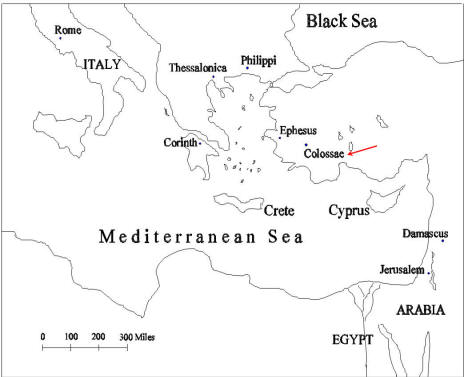
Colossae was a minor city about one hundred miles east of Ephesus. It is by a mountain pass and was once a very populated city with a vibrant economy. By the time of the writing of this epistle, Colossae had withered economically due, in part, to the success of its neighboring cities.


There is some doubt as to whether Paul ever visited Colossae, and, apparently, the Colossian church was founded by Epaphras (Col 1:4-8; 2:1).

Colossians was probably written about the same time as Philemon and Ephesians when Paul was first imprisoned in Rome. If this is accurate, then Colossians was probably written around 60 A.D.

The letter was written in response to a heresy that was developing within the church. Though it is not known exactly what the heresy was, it apparently was a religious system that combined elements from Greek speculations (Col 2:4; 8-10), Jewish legalism (Col 2:11-17), and Oriental mysticism (Col 2:18-23).

Selengkapnya...(Read More)

The Unjust Steward, Luke 16:1-8

A. Now He was also saying to the disciples, 'There was a certain rich man
who had a steward, and this steward was reported to him as squandering
his possessions. Rich Man and Steward

B. And he called him and said to him, "What is this I hear about you?
Give an account of your stewardship, for you can no longer be steward." Problem

B. and the steward said to himself, "What shall I do, since my master is
taking the stewardship away from me? I am not strong enough to
dig; I am ashamed to beg. Problem


C. I know what I shall do, so that when I am removed from the
stewardship, they will receive me into their homes." Idea

B. And he summoned each one of his master's debtors, and he began saying
to the first, "How much more do you owe my master?" And he said, "A
hundred measures of oil." And he said to him, "Take your bill, and sit
down quickly and write fifty." Solution

B. Then he said to another, "And how much do you owe?" And he said,
"A hundred measures of wheat." He said to him, "Take your bill, and
write eighty." Solution

A. And his master praised the unrighteous steward because he had acted shrewdly;
for the sons of this age are more shrewd in relation to their own kind than the
sons of light. Rich Man and Steward


Many commentators agree that this parable is the most difficult of all the parables to interpret. In fact, it is interesting to note that there are other "unsavory" characters in Jesus" parables: The unjust judge, the neighbor who does not want to be bothered in the night, and the man who pockets someone else's treasure by buying his field.

The seeming incongruity of a story that praises a scoundrel has been an embarrassment to the Church at least since Julian the Apostate used the parable to assert the inferiority of the Christian faith and its founder. We need a more precise understanding of the culture that affects this text.

The disciples are the primary audience, but the Pharisees are also included (v. 14).

Questions to ask:

1. Is the master assumed to be an honorable man, or is he a partner-in-crime with his steward?
2. Has the steward obliged the renters to sign bills for amounts greater than the actual debts?
3. Is his reduction of the debts merely a surrender of his dishonest cut?
4. Is the steward an estate manager dealing with land rentals or is he an authorized agent for a moneylender?

The most probable cultural setting for the parable is that of a large estate consisting of land divided into portions, where the steward is entrusted with carrying the business of that estate. The debtors are most likely renters who had agreed to pay a fixed amount of produce for the yearly rent. The steward was no doubt making extras "under the table," but these amounts were not reflected in the signed bills. He was a salaried official who, in addition, was paid a specific fee by the renter for each contract. The master was a man of noble character respected in the community who cared enough about his own wealth to fire a wasteful manager, and this is the key to understanding this parable.

Mishnah, a Hebrew term meaning "repetition" or "study," is the name given to the oldest postbiblical codification of Jewish Oral Law. Together with the Gemara (later commentaries on the Mishnah itself), it forms the TALMUD. Between 400 BC and the beginning of the Christian Era, the biblical laws (see TORAH) were intensively studied, applied to new situations, and supplemented by traditions of popular observance and by precedents established by prominent leaders. This material, long transmitted by word of mouth and known as the Oral Torah, defined the meaning of biblical laws. After the fall of Jerusalem and the destruction of the Temple in AD 70, the Jewish scholars and teachers called tannaim continued to elaborate and systematize the Oral Torah. About AD 200, Rabbi JUDAH HA-NASI promulgated a collection of the most reliable traditions. This work, the Mishnah, became the official text out of which further Jewish legal development occurred.

1. Now He was also saying to the disciples, 'There was a certain rich man who had a steward, and this steward was reported to him as squandering his possessions.
Someone apparently cared enough about the master to tell him something was wrong.
Often tenants disliked the landowners and would not voluntarily help him.


2. And he called him and said to him, "What is this I hear about you? Give an account of your stewardship, for you can no longer be steward."
The servant does not know how much the master knows and may be frightened into divulging information the master does not have. So, he remains silent.


3. and the steward said to himself, "What shall I do, since my master is taking the stewardship away from me? I am not strong enough to dig; I am ashamed to beg.
The steward remained silent. He does not defend himself. In the culture of the time, this is almost an admission of guilt. He thinks of a way to cover himself after he has been let go.
It is not known if the steward is fired now or later? Is he asked to get the books now or get them ready to be examined?


4. I know what I shall do, so that when I am removed from the stewardship, they will receive me into their homes."
The steward acts as though he is not yet fired: he says, "when I am removed..."; yet, earlier, the landowner had said, "you can no longer be steward," present tense. So, it is most likely that he was fired on the spot. But, the word apparently isn't out yet.


5. And he summoned each one of his master's debtors, and he began saying to the first, "How much more do you owe my master?"
The steward does not say "Hello" or "Friend." He is in a hurry.


6. And he said, "A hundred measures of oil." And he said to him, "Take your bill, and sit down quickly and write fifty."

f the renters know that the steward has been fired and they agree to the deal they would risk being thrown off the land by the landowner, not to mention sinning in their dishonesty. The relationship between the owner of the land and his renters is a significant personal and economic relationship. "Take your bill, and sit down quickly and write fifty" is an attempt by the steward to finish before the master finds out what is going on.


7. Then he said to another, "And how much do you owe?" And he said, "A hundred measures of wheat." He said to him, "Take your bill, and write eighty."

If the renters did not think that the steward was acting with the approval of the landowner they would not have agreed; the risk would be too great.

In this account, the steward receives credit for having arranged such a good deal between the landowner and the renters.

The renters, would be very appreciative and indebted to the steward.
Generally, reductions of rent were expected if the conditions warranted it: a dried spring, fruit trees drying, drought, etc. But the renters would have to ask for the reduction and then proceed to haggle. Here, though, the reduction is unsolicited.


8. And his master praised the unrighteous steward because he had acted shrewdly; for the sons of this age are more shrewd in relation to their own kind than the sons of light.

Why does the landowner praise the unjust steward?
It would be quite safe to assume that there is some sort of celebrating occurring in the homes of the renters as they rejoice in, what they think is, the generosity of the landowner.


Soon the whole community would be aware of the kind heartedness of the landowner and would be happy with the renters as well as thinking honorably of the generous landowner.

He has two alternatives: First, he could gather the renters and tell them that the reductions were unauthorized and thereby showing his stinginess and risking ridicule from them and the community. Second, he can keep silent, accept the praise that is even now being showered on him, and allow the clever steward to get away with the scheme.

Obviously, the steward knew the master was a generous person, otherwise he would not have taken such a risk; after all, he wasn't jailed to begin with.

In verse 9 Jesus is not praising the dishonesty, but the ability of the steward to recognize the generosity of his master, see what was coming, and use what he had at the time to obtain something far greater: self preservation.

This is significant. The fear of the Lord is the beginning of Wisdom. God can condemn you to eternal damnation. It is wise to seek a way out of that. In fact, the judgment of damnation is so terrible, that praise is offered to the one who, in desperation, seeks a way out of it.

If the unrighteous steward was praised for trusting the master, how much more will you be rewarded if you trust the true and holy Master, the Lord Himself.

Jesus uses the rabbinic principle of showing "how much more." That is, if the widow got what she wanted from the judge (18:1-9), how much more you and God? If the man got bread in the night from his neighbor (11:5-7), how much more you from God?

What, then, does the parable typify?

1. God (the master) is a God of judgment and mercy.
2. Because of his evil, man (the steward) is caught in the crisis of the coming of the kingdom.
3. Excuses will avail the steward nothing.
4. Man's only option is to entrust everything to the unfailing mercy of his generous master who, he can be confident, will accept to pay the price for man's salvation.

The steward was vindicated because he completely trusted the master to be generous, to be good. He was right in doing so!!!

This parable is an appeal to people to understand the nature of God.

1. The nature of God: He is merciful
2. The predicament of man: he is sinful
3. The ground for salvation: complete trust in God.
4. How much more dishonest to God are we?
5. How much more deceitful are we?
6. How much more do we owe to God?
7. How much more merciful is God than the rich man?

God (the master) is a God of judgment and mercy. Because of the steward's evil behavior, he is found out. This is representative of the coming kingdom of God and its associated judgment. Excuses will avail the steward nothing. Man's only option is to entrust everything to the unfailing mercy of his generous master who, he can be confident, will accept to pay the price for man's salvation. This clever scoundrel was wise enough to place his total trust in the quality of mercy experienced at the beginning of the story. That trust was vindicated. Christians need the same kind of wisdom.

Who is God to you?

What do you think of Him?

How do you perceive Him?

Is He mean? Loving? Kind? Impatient? Judgmental?

How you perceive God will determine

* how you respond to Him
* how you address Him
* how often you call upon Him
* How you view troubles
* .....and how much you trust Him.

How much more merciful is God than the rich man?

Selengkapnya...(Read More)

The Good Samaritan Luke 10:25-37

by Matt Slick

Theme: What must I do to inherit eternal life?

25. And behold, a certain lawyer stood up and put Him to the test, saying, "Teacher, what shall I do to inherit eternal life?"
Lawyer: One who is an expert in the Law of Moses. Often this individual was called upon to settle legal issues. "He stood up." This is a social courtesy and a greeting of respect. Yet, in his heart he sought to test Jesus. This is a contradiction between his actions and his words.


26. And He said to him, "What is written in the Law? How does it read to you?"
Jesus asks the lawyer about what he knows best: the law. He knows that keeping the law is the appropriate answer. He brings the issue out into the open. This is probably best since the Jewish leadership were probably concerned about Jesus' teachings on the Law.


27. And he answered and said, "You shall love the LORD your God with all your heart, and with all your soul, and with all your strength, and with all your mind; and your neighbor as yourself."

It is interesting that this man of the law would quote something regarding love and not some ritual or set of rules.

The standard set here is one which no one could keep.

Perhaps he was testing Jesus by quoting what Jesus had taught before: love.


28. And He said to him, "You have answered correctly; Do this and you will live."

Jesus, the man, instructs the man of the law, "You have answered correctly."


29. But wishing to justify himself, he said to Jesus, "And who is my neighbor?"

The Lawyer does not show humility by saying something like, "How can I do this, since I am an imperfect and sinful man?" Instead, he seeks to justify himself.

This is often the case with experts in moral law; they think they have their own lives covered pretty well because they look at their actions, not their hearts.

The expected reply would be something like, "Your relative and your friend." Then the lawyer would be able to say that he has done this and thereby enjoy honor among the people there listening; However, Jesus said...


30. Jesus replied and said, "A certain man was going down from Jerusalem to Jericho; and he fell among robbers, and they stripped him and beat him, and went off leaving him half dead.

Jesus expounds on the law of love. True love is put into action. It is not merely at concept or a feeling.

There is a road that goes down from Jerusalem to Jericho. It is 17 miles long and drops about 3,000 feet in those 17 miles. It has long been a hazardous trip due to thieves and robbers.

Jesus intentionally leaves the man undescribed. The audience, being Jewish, would naturally assume that he was a Jew. Being in this half dead state he would be unconscious.

Since he is stripped, he then is unidentifiable. Historically, a person can be identified in one of two ways: his dress and his speech, i.e. dialect. The man is any person: void of ethnic background, void of stature, void of position


31. "And by chance a certain priest was going down on that road, and when he saw him, he passed by on the other side.

Since, he moves to the other side, probably the priest did not actually see it happen. How can he be sure the wounded man is a neighbor since he cannot be identified? If the person lying there is a non Jew the priest could be risking defilement, especially if the person were actually dead. If he defiles himself he can not collect, distribute, and eat tithes. His family and servants will suffer the consequences with him.

Priests were supposed to be ritually clean, exemplars of the law. There would be immediate shame and embarrassment suffered by them at the expense of the people and their peers for such defilement. Having just completed his mandatory two weeks of service, he would then need to return and stand at the Eastern Gate along with the rest of the unclean. Furthermore, in addition to the humiliation involved, the process of restoring ritual purity was time consuming and costly. It required finding, buying, and reducing a red heifer to ashes, and the ritual took a full week. The priest is in a predicament. Moreover, he cannot approach closer than four cubits to a dead man without being defiled, and he will have to overstep that boundary just to ascertain the condition of the wounded man.


32. "And likewise a Levite also, when he came to the place and saw him, passed by on the other side.
"Levites were descendants of Levi but not of Aaron, and they assisted the priests (Aaron’s descendants) in the temple."1

The road spoken of here is a long one. It is very likely, according to those who have walked it, that a person traveling it, could see ahead of him a long way. The Levite, who is of a lower social class, may have been walking. He most probably saw the priest ahead of him and could have thought to himself, "If the priest may pass then so should I."

Perhaps they might fear for their own safety. What if someone saw them with the naked and wounded person and reported to the officials that the priest and/or Levite committed a crime against the injured person?


33. "But a certain Samaritan, who was on a journey, came upon him; and when he saw him, he felt compassion,

The Samaritans were a mixed race between the Jews of captivity and the Samaritan people of the land they were captive in. The relationship between the Jews and Samaritans was one of hostility because of some bad things that happened in the past. According to the Mishna, "He that eats the bread of the Samaritans is like to one that eats the flesh of swine" (Mishna Shebiith 8:10). The Mishna is the oral traditions that developed about the law, containing interpretations and applications to specific questions which the law deals with only in principle. Specifically, it is the collection of these traditions.

The Samaritan is not a gentile. He is bound by the same law as the Jews. The Samaritan would not be naturally from that area, so the half dead man would certainly not qualify as his neighbor.

"The Samaritan woman therefore said to Him, “How is it that You, being a Jew, ask me for a drink since I am a Samaritan woman?” (For Jews have no dealings with Samaritans.)" (John 4:9).

"The Jews answered and said to Him, “Do we not say rightly that You are a Samaritan and have a demon?” 49 Jesus answered, “I do not have a demon; but I honor My Father, and you dishonor Me,'" (John 8:48-49)


34. "and came to him, and bandaged up his wounds, pouring oil and wine on them; and he put him on his own beast, and brought him to an inn, and took care of him.
The Samaritan risks defilement. He approaches this unidentifiable man and helps him.

Oil and wine were poured out on the high altar before God. Note how the usage is mentioned after the Priest and Levite have failed to do their duty.

Blood revenge: "Mosaic legislation established cities of refuge for people under the threat of death from blood vengeance retaliation. This legislation provided an escape valve for a custom it could not eradicate."
Often when the guilty cannot be reached, vengeance may be administered to a member of his family. Often the vengeance would reach even to the most distant relations of the offending party.

"Irrational minds seeking a focus for their retaliation do not make rational judgments, especially when the person involved is from a hated minority community."


35. "And on the next day he took out two denarii and gave them to the innkeeper and said, 'Take care of him; and whatever more you spend, when I return, I will repay you.'

The Samaritan forfeits anonymity when he stays overnight and then says he would return. This is an acceptance of the potential threat of blood vengeance.

The wounded man has no money. When it is time for him to leave, if he cannot pay the debt he can be arrested, Matthew 18:23-35. The Samaritan knows this and volunteers money (two danarri is two days wages) and whatever else is needed to see to the needs of this unidentified man. Additionally, the Samaritan had no way of insuring the return of his money. Therefore, it is safe to assume he did not expect it to be returned.


The Robbers Priest and Levite The Samaritan
Rob him Harm him by inaction Pays for him
Leave him dying Leave him unhelped Leaves him cared for
Abandon him Neglected him Promises to return


36. "Which of these three do you think proved to be a neighbor to the man who fell into the robbers' hands?"
Jesus refuses to define who a neighbor is. Instead He asks a question proving something greater than the exact answer anticipated. Being a neighbor to someone is not limited to family relations or proximity. It is showing the love of God to all who are in need, who ever they may be, where ever they may be.


37. And he said, "the one who showed mercy toward him." And Jesus said to him, "Go and do the same."
The Samaritans were so hated by the Jews that perhaps this lawyer did not want to comment on a "Samaritan" and instead said, "the one who showed mercy toward him."

The discussion began with a question: what must I do inherit eternal life. The conclusion is answered with what must be done.
If we are to do this, we will quickly find that we are incapable of completing so perfect a love. Since the law requires perfect obedience, the doing of this lesson would be something most difficult for the lawyer.


This parable teaches the impossibility of earning one's salvation. The standard, which is perfect love, is too high.

It holds up an ethical level for us to strive for, see Matthew 5:48.

It attacks racial prejudices.

It teaches that love is something you feel and do.

----------

Walvoord, John F., and Roy B. Zuck, The Bible Knowledge Commentary, (Wheaton, Illinois: Scripture Press Publications, Inc.), 1983, 1985.

Selengkapnya...(Read More)